
1
We took on availability across a fourteen-supplier network
The reach of a brand-agnostic distributor is its advantage. It is also what makes availability a genuinely hard engineering problem.
UK Valves Direct supplies industrial flow-control equipment into water treatment, HVAC, oil and gas, chemical processing, food and beverage, pharmaceutical, marine, power generation and mining, dispatching next-working-day on stocked items ordered before the afternoon cut-off from its West Midlands depot.
Like every distributor operating this model, it carries far more in its catalogue than on its shelves. Around 780 SKUs are depot-held. The rest sit with manufacturers and stockists across the supply network, to be drop-shipped or transferred in on demand. That is precisely what a customer is buying: one relationship instead of fourteen, and access to a range no single warehouse could hold.
The engineering consequence is that a single availability figure has to be assembled from fourteen sources that report stock in fourteen different ways. Two order paths depended on it. Instant checkout resolved availability to a single in-stock flag. The quote desk handled bulk orders, project bills of materials, competitor part-number cross-references and custom actuation packages, against a published commitment of two to four working hours, with technical sales confirming availability supplier by supplier.
Both paths worked. Neither could express the one thing the underlying data actually varied on, which is how firmly a given figure was known.
In industrial supply, a delivery date is a commitment somebody else has planned a shutdown around.
That is what raises the stakes on a lead time in this sector relative to general ecommerce, and it is why the business wanted the model rebuilt rather than patched. A second consideration was cost of attention: sales engineers who can size an actuator and read a flange table are the scarcest resource in the building, and a meaningful share of their week was going on reconciling supplier stock data by hand.
2
We audited every SKU to find its true stock source
We mapped every product category to its actual stock source and catalogued how each supplier's availability could be obtained. The picture is typical of the sector.
Of roughly 1,850 saleable SKUs, around 780 are depot-held. The remainder are supplier-held across fourteen trading relationships. Three of those suppliers offer a machine-readable feed: two an EDI 846 Inventory Inquiry/Advice, one a REST API. Four can produce a scheduled CSV drop to FTP, refreshed nightly. The remaining seven, which between them hold most of the specialist and large-bore lines, publish nothing machine-readable at all. Availability comes by phone, by email, or from a PDF price list that carries prices rather than quantities.
You cannot build a real-time stock layer on top of suppliers who do not have real-time stock data.
This is the finding most inventory-integration proposals skip past, and getting it on the table in week one is what kept the project honest. Even where EDI exists, the 846 is a snapshot transaction rather than a live query. It reports what was true when it was generated, typically overnight. Industry-wide, supplier compliance with agreed EDI specifications averages well under half. An architecture that assumes otherwise is designed for a supply base that does not exist, and would have failed quietly in production rather than loudly in the audit.
3
We timed the quote desk before changing anything
We instrumented the quote desk for three weeks and timed each stage before committing to a single target.
Availability confirmation accounted for a substantial share of elapsed time on standard quotes. On complex quotes it was dwarfed by specification clarification: establishing whether the customer needs PN16 or Class 150, which flange table they are mating to (BS EN 1092-1, ASME B16.5, or a legacy BS10 Table D/E/F that tends not to come up until the valve arrives), whether EPDM or Viton suits the media, whether "stainless" means 316 bar or a CF8M cast body, and what a competitor part number actually cross-references to.
That work is the service. It is the reason customers route a project bill of materials through a technical desk instead of a search box, and no amount of stock automation touches it. Measuring first is what stopped us scoping a tool against the smaller half of the problem and committing to targets the architecture could not reach.
Before the rebuild
26h median elapsed
After the rebuild
9h median elapsed
Specification clarification14h 50m → 6h 20mhuman work, left alone
The dominant cost on a complex quote. No stock automation reaches it; it improved because availability is settled before the conversation starts.
- Standard quotes
- 2 to 4 working hours
- Complex specifications
- 24 hours
- Actuated assemblies
- 1 to 2 working days
Published response commitments the desk had to keep throughout
Three weeks of instrumentation before any target was set.
4
We made certification a sourcing constraint
Documentation is a sourcing constraint rather than a paperwork step that follows one, and it is the requirement inventory projects in this sector most often discover late.
A large share of orders here carry documentation requirements: WRAS approval for potable water, ATEX for equipment in explosive atmospheres, PED and PER pressure-equipment conformity, API 607 or 6FA fire-safe certification on soft-seated quarter-turn valves, and above all EN 10204 3.1 material certificates.
A 3.1 certificate is tied to a specific material heat and batch number. An order carrying that requirement cannot be filled from whichever source shows stock; it has to come from material with matching traceable paperwork, which on most lines is a small subset of what physically exists. Any available-to-promise calculation that treats units as fungible will therefore overstate what can be supplied against the documentation. Carrying certification as a first-class sourcing constraint, rather than checking it at pick time, is what makes the promise reliable.
EN 10204 3.1 material certificate
Tied to a specific material heat and batch, so the order must be filled from stock with matching paperwork.
Units the engine can legitimately count, by source
- West Midlands depot6
- Cast and ductile valve maker14
- Stainless valve maker9
- Control valve manufacturer4
- Flange and gasket stockist11
- Knife gate specialist7
- Actuator distributor5
- Seal and elastomer supplier0
- Large-bore forging house3
- Cryogenic specialist2
- Marine fittings supplier4
- High-pressure specialist2
- Hygienic flow specialist0
- Potable water specialist8
- Special alloy stockist1
Unconstrained aggregation would offer
76units
Documentation-constrained ATP
6units
3 of 15 stock sources eligible
Same SKU, same physical stock. Only the paperwork the customer needs changes.
Treating units as fungible overstates what can be supplied against the documentation.
5
We built an availability system that shows its evidence
A middleware service normalising every source into one availability figure per SKU, with the evidence behind it travelling alongside the number.
Each figure is stamped with its source tier, its age and a confidence state. Verified means a depot count or a live feed under two hours old. Indicative means a feed or CSV under twenty-four hours old, with a safety-stock buffer applied and a despatch window shown. Lead-time only means no availability data exists for that line, so the page states a realistic despatch window instead of a quantity.
SKU cross-reference tables handle part-number and unit-of-measure normalisation between supplier schemes and internal SKUs. Certification requirements ride along as sourcing constraints, so an order flagged for 3.1 documentation only ever draws on stock that can produce it.
The interesting engineering is not in consuming an API. It is in an availability model that degrades gracefully: one that can hold "I know this precisely", "I know this approximately as of last night" and "this one is lead-time quoted" in the same schema, and surface each appropriately to both a checkout page and a sales engineer.
The approach has good precedent in the sector. All Valves Online run a public green, amber and red indicator with an explicit statement that a red item is available from suppliers in roughly seven to ten days, and openly note that a green item may sell during the working day.
Customers in this market do not require perfect availability. They require accurate availability, because they are planning installations around it.
The commercial case follows from that. Baymard Institute research finds around 30% of shoppers abandon entirely when told only that an item is out of stock, and that most sites offer no route to order a temporarily unavailable item. Replacing a binary state with a credible lead time converts a share of those into orders, which is why the lead-time-only tier earns its place rather than merely being the honest option.

Home / Valves / Lugged butterfly valve, ductile iron
Schematic, section through the flow path
BFV-DN100-LUG-EP
Lugged butterfly valve, ductile iron
DN100 · PN16 · EPDM liner · BS EN 1092-1 PN16 drilling
£212.75ex VAT
Available from supply network
- Quantity
- Held in quantity
- Source
- Supplier feed, generated 02:14, read 11:06
- Despatch
- Despatch in 2 to 3 working days
From an overnight snapshot with a buffer applied, so the quantity is banded rather than exact.
Illustration, not a working storefront
What a single flag could not express
Came from an overnight EDI 846, so it described the network at 02:00 rather than at the moment of ordering.
Rule that produced indicative
Feed or CSV under twenty-four hours old, safety-stock buffer applied. A banded availability and a despatch window, never a bare in-stock flag.
Sourced from Cast and ductile valve maker
Same page, same layout. The availability panel is the entire difference.
6
We routed actuated assemblies to the build bench
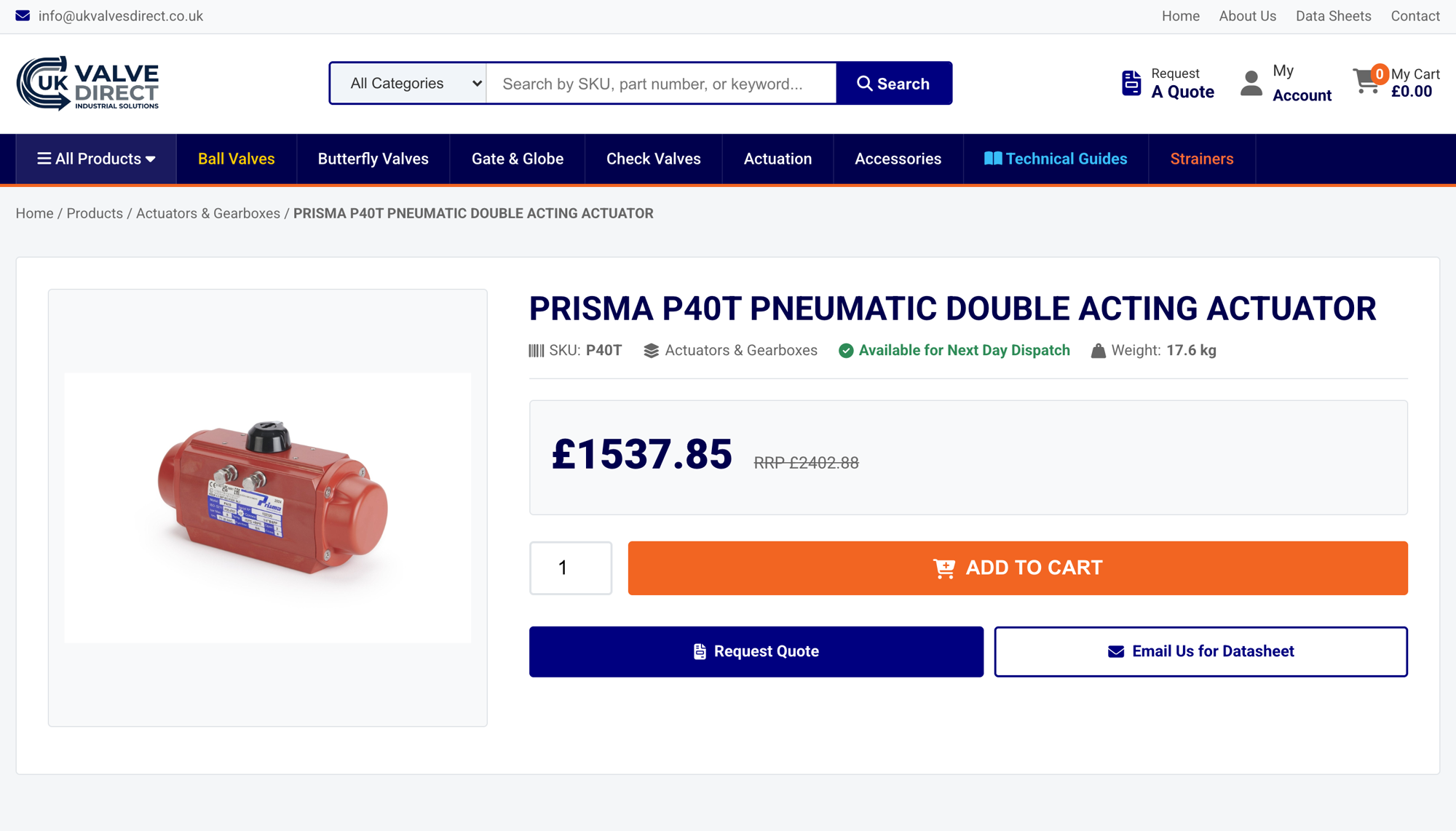
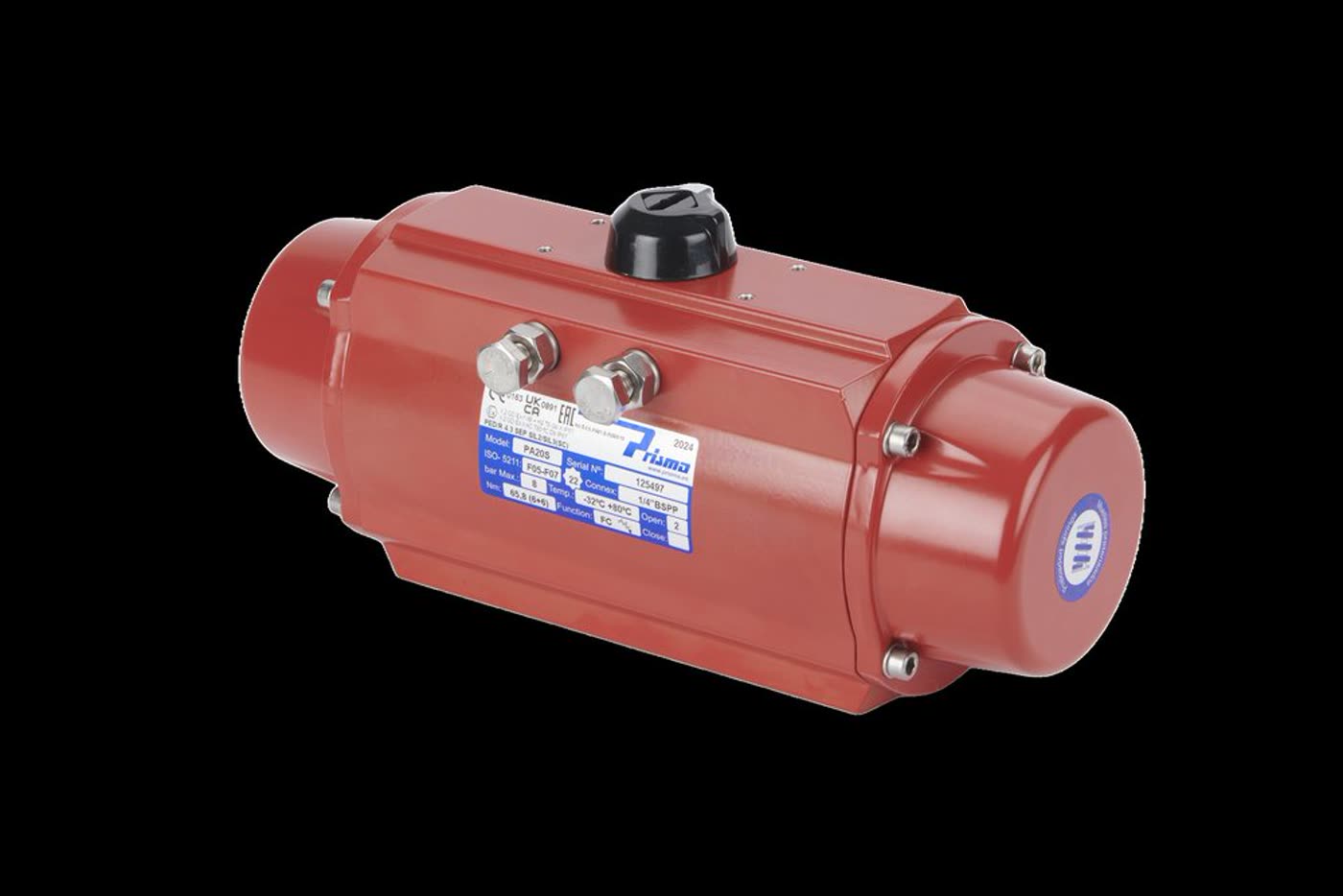
An actuated valve is not a stocked item with an accessory attached. It is an assembly built to order, and the lead time has to reflect the work.
The actuator is sized against the valve's break-away, running and seating torque under actual differential pressure, seat material and temperature, with a safety factor applied: commonly around 1.3 to 1.5 times for ball valves and roughly double for butterfly valves, where dynamic torque is significant. The result has to stay within the valve's maximum allowable stem torque. Spring-return units are checked at minimum available air supply rather than nominal. Valve and actuator have to share a compatible ISO 5211 mounting interface, or the assembly needs a bracket and coupling to bridge it. The finished unit is then dry-bench function tested before it ships.
That is a manufacturing process with its own queue, and the routing now recognises it as one. Assemblies are identified at the point of order from the SKU's build flag and sent to the build bench with a lead time that matches the work, rather than inheriting the despatch path of a boxed item.
Valve size
Duty conditions the sizing has to allow for
- Break-away torque96 NmButterfly valve, resilient seated at DN150, at rated differential pressure.
- Safety factor× 2Roughly double, because dynamic torque across the disc is significant and rises with differential pressure.
- Duty modifiers× 1.151 condition applied.
- Required torque221 Nm96 × 2 × 1.15, delivered at minimum air supply.
Actuator selected
PA-260 DA. 233 Nm at minimum air, 310 Nm nominal.
Within maximum allowable stem torque
221 Nm against a 240 Nm limit.
ISO 5211 interface, valve F10
Actuator presents F10. Direct mount.
Dry-bench function test
Stroked and proved on the bench before it ships.
Routing verdict at the point of order
Build bench, 5 to 7 working days
Four checks, any of which can send the order to the desk instead of the bench.
7
We gave every delivery route its own promise
Five paths, each carrying the lead time its physical process can actually support.
Every order line now classifies on its true stock source, its build flag and any documentation requirement travelling with it, then routes accordingly: depot pick, supplier drop-ship, inter-supplier transfer, build bench, or indent. A depot pick and a duplex indent are different operations, and the customer now sees a date derived from the one that applies.
The quote desk gained the same data. Live availability, lead time, cost and current volume-break pricing surface inside the quotation workflow, keyed to the customer's application and quantity tiers. For the seven suppliers without feeds the tool generates a pre-filled availability request and logs the response back against the SKU, so a check made once for a quote improves the answer for everyone who looks at that product next. The manual work that remains is captured rather than repeated.
Left deliberately untouched: the technical conversation. Specification matching, actuator sizing and cross-referencing stay with the sales engineers. The objective was to give them their week back, not to automate the expertise customers come to them for.
Order line received
Classified on the SKU's true stock source, its build flag and any documentation requirement carried with the line.
Build bench
5 to 7 working days, including dry-bench function test
Caught at the point of order by the build flag. Sizing, mounting, assembly and test have their own queue.
Before
Inherited a boxed valve's lead time. The highest-value change in the routing.
One promise per path, set by the physical process behind it.
8
We cut substitutions by 74% and quote time by 73%
Measured across matched thirteen-week windows either side of cutover, from the client's own order, quote and helpdesk records.
Two results are worth reading closely, because in both the honest number is the less impressive one.
Manual supplier checks fell by roughly three quarters rather than to near zero. Seven suppliers still publish nothing machine-readable, and the thirty-odd checks a week that remain are irreducible until that changes. We reported the ceiling in the final report rather than projecting a number the architecture could not reach.
Complex quote turnaround improved less, proportionally, than standard. That is specification work reasserting itself, exactly as the instrumentation predicted, and it is the shape you should expect when the dominant cost is engineering judgement rather than data retrieval. Setting the targets after the measurement rather than before it is why both landed.
Select a metric for how it was measured. Operational counts, not audited financials.
9
We can apply the same pattern to other distributors
The pattern applies to any distributor whose catalogue is larger than its warehouse: industrial MRO, electrical and pipeline supply, plumbing and heating merchants, hydraulics, bearings and power transmission, laboratory and process equipment.
What carried the engagement was not the integration work. It was deciding what the business could evidence, and then building something whose promises are bounded by that.
What proportion of your catalogue can you state availability for with evidence, and what proportion is inferred?
Most distributors have never had cause to measure the gap. Closing it shows up in fewer substitutions, lighter support load, and technical staff spending their time on specification rather than on data entry.
- Mixed-source ATP
- Real-time inventory aggregation across a network with genuinely mixed data quality, including suppliers with no machine-readable data at all, rather than a single clean warehouse feed.
- Calibrated promises
- An availability model that expresses confidence and provenance, so customer-facing commitments are bounded by what the business can evidence rather than by what the schema can represent.
- Tooling, not replacement
- Turning a manual, relationship-based B2B quoting process into a data-backed workflow without automating away the technical sales relationship that differentiates the business.
- Routing by physics
- Fulfilment routing that distinguishes stocked goods from build-to-order assemblies, with lead-time promises that match the physical process behind each.
- Diagnostic honesty
- Instrumenting the process before committing to targets, and reporting the ceiling on what integration could achieve given the supply base, including where that ceiling sat lower than anyone hoped.
How much of your catalogue can you evidence?
If a meaningful share of what you sell sits on someone else's shelves, the gap between what you can evidence and what you state is worth measuring. A 30 minute call is enough to size it.