
AI consulting
Find revenue you didn't know was there.
Agents search your whole business for opportunities and research your hardest decisions.
── Pods deployed with ──






What we do
Search the whole business
Agents read across your systems and your market at a breadth no team has time for.
Find hidden revenue
Customers ready to buy more, prices left flat for years, demand nobody is answering.
Research the decision
The acquisition, the market entry, the build-or-buy question. Agents assemble the evidence in days, not quarters.
Rank what's worth doing
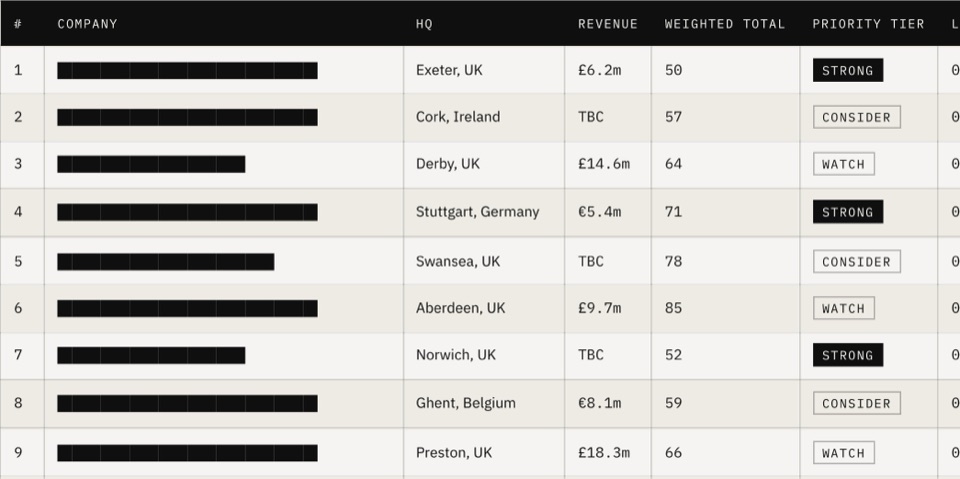
A shortlist scored by value and effort, each entry carrying the evidence behind it.

How we do it
- 1
Map the ground
We connect agents to your systems and the market around you.
- 2
Run the sweep
Pricing, customers, operations, competitors, searched in parallel.
- 3
Go deep on the finds
The promising ones get researched to decision depth.
- 4
Hand over the shortlist
Ranked opportunities, each with evidence and a build path.
Finding opportunity is a search problem now.
Breadth first
Hundreds of leads scanned cheaply, so the few real ones get investigated properly.
Your data, finally read
The CRM, the tickets, the spreadsheets. Most companies own more answers than they have ever read.
Evidence attached
Every finding carries its sources, so you can check the claim before you act on it.
Judgment stays yours
Agents build the case. Your leadership makes the call.
What you'll achieve
Revenue you weren't counting
Opportunities sized in pounds, found in data and markets you already had access to.
Decisions made on evidence
The next big call gets made on assembled research rather than the loudest voice in the room.
A build path, not a deck
Each recommendation says what capturing it would take. When you want it built, that is what we do.

Common questions
What does AI consulting actually involve?
We connect agents to your systems and the market around you and set them searching, both for revenue opportunities you did not know existed and for the evidence behind decisions you already know you have to make. What comes back is a ranked shortlist with sources attached, not a deck of hunches.
How is this different from traditional consulting?
A traditional engagement interviews a dozen people and reasons from what they said. Agents read the actual record, every account, every ticket, every filing, at a breadth no team of consultants can match. The conclusions arrive with the evidence they stand on.
What kind of opportunities turn up?
Customers whose usage says they are ready to buy more. Prices that have not moved since the spreadsheet was made. Demand arriving through channels nobody watches. Manual work expensive enough to be worth a product. Most of it was visible all along; nobody had time to look.
Can you research a specific decision we already face?
Yes. An acquisition, a market entry, a pricing change, a build-or-buy question. Agents assemble the case to decision depth in days rather than quarters, and you see every source they used.
Tell us what you need built.
A 20 minute call is enough to work out whether a pod fits. The first week of work is defined on that call.
As seen in