
“Working with Algosoup has been brilliant. The speed, communication and quality of delivery have genuinely impressed us. I wouldn't have believed we could go from an initial concept to demoing a live product with a customer in just four weeks, without compromising on quality.”
 Joe Adams · Co-Founder and Director, Tangent
1
Tangent wanted its mentoring to make better leaders, starting with sales managers
Tangent is an AI talent network for job seekers from low-income backgrounds. Managers at member companies mentor those job seekers, and Tangent had noticed the mentors were developing as leaders too. Learn by Mentoring turns that into a product: a leadership-skills gym where a manager learns one skill, rehearses it safely and sees their progress. Sales enablement is the first vertical because its return is the easiest to measure.
The brief was a one-page proposition from Tangent and a technical specification we wrote together, then iterated with Joe Adams, Tangent's co-founder, in the open rather than through wireframes. Tangent created the Google Cloud project and covered the running costs. We covered the engineering, and everything we built belongs to Tangent.
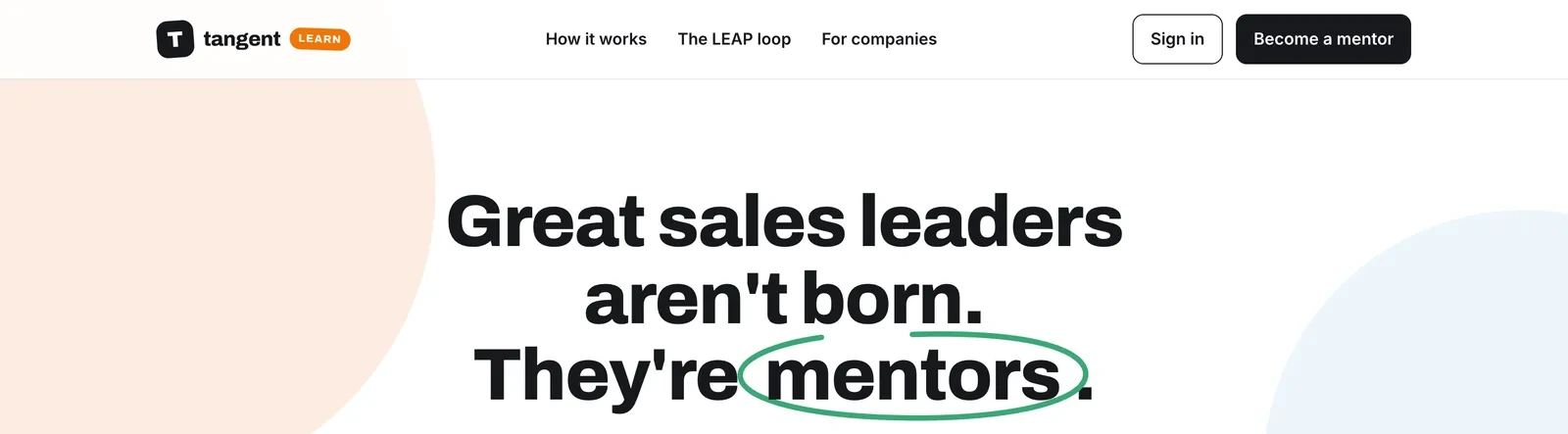
 Learn by Mentoring
The skill loop
What the mentor does at each step, and who is in it with them.
Learn
The mentorTakes a short chapter: a narrated lesson, a worked example and a knowledge check
The AI narratorNarrates each scene in a British e-learning voice, with captions
Practice
The mentorCoaches an AI mentee in a live voice call, then reads the debrief
The AI menteePlays the mentee in the scenario, then scores the transcript against the chapter's behaviours
Progress
The mentorWatches six competency scores move and downloads a report for their manager
The AIIts rehearsal scores are what move the six competencies. Chapters and quizzes never do
2
A mentor's first login sets a locked baseline across six competencies
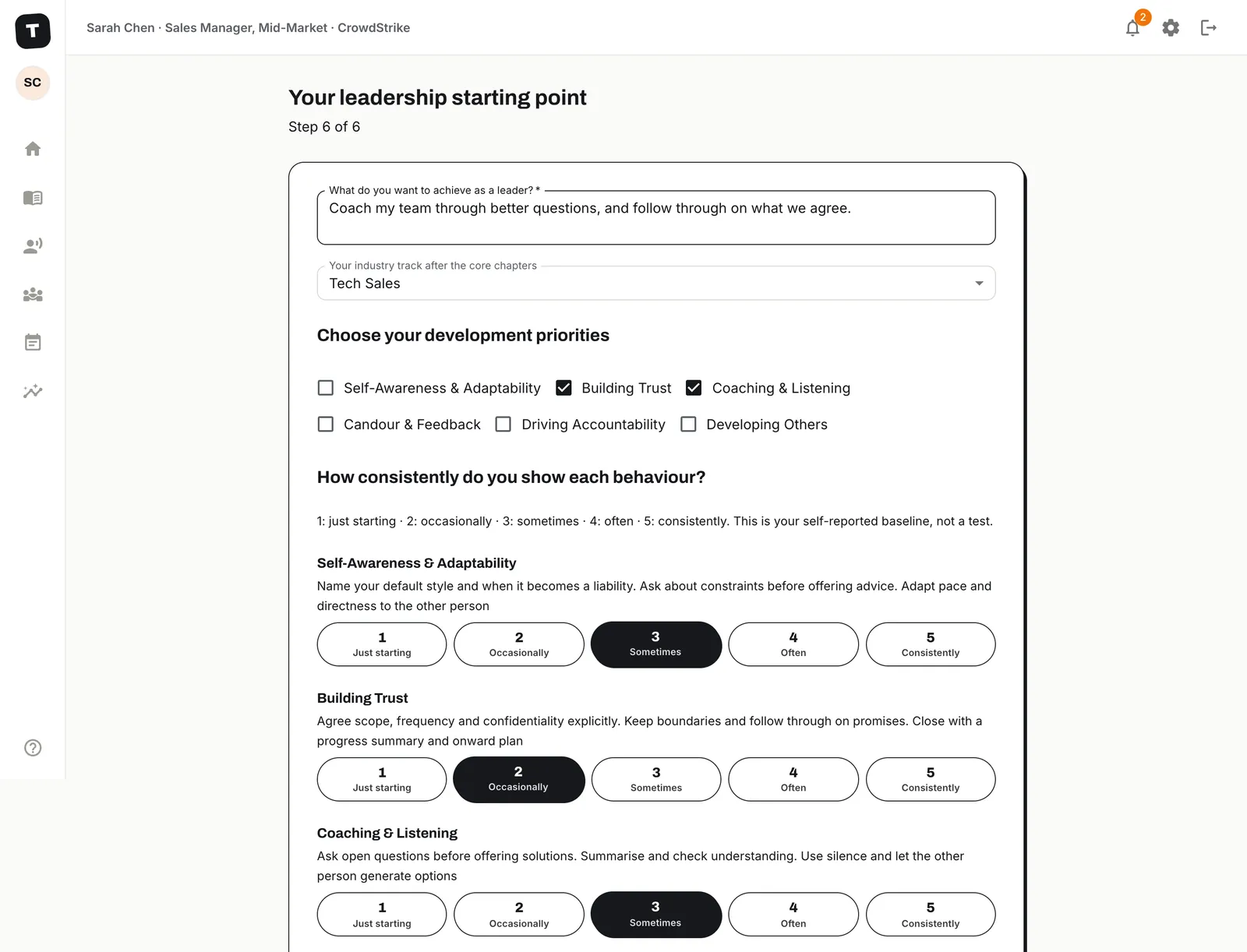
Sign-in leads into a short tour that points at each part of the product, then a baseline: a goal, development priorities, an industry track and a self-reported score on each of six competencies, tapped on a pill scale. Saving locks it. Everything that happens afterwards is measured against that starting point, so the progress page can show an honest comparison rather than a number that drifts.
The six competencies and their eighteen observable behaviours are Tangent's own framework. We encoded it directly, chapter by chapter, rather than generating curriculum content with a model.
3
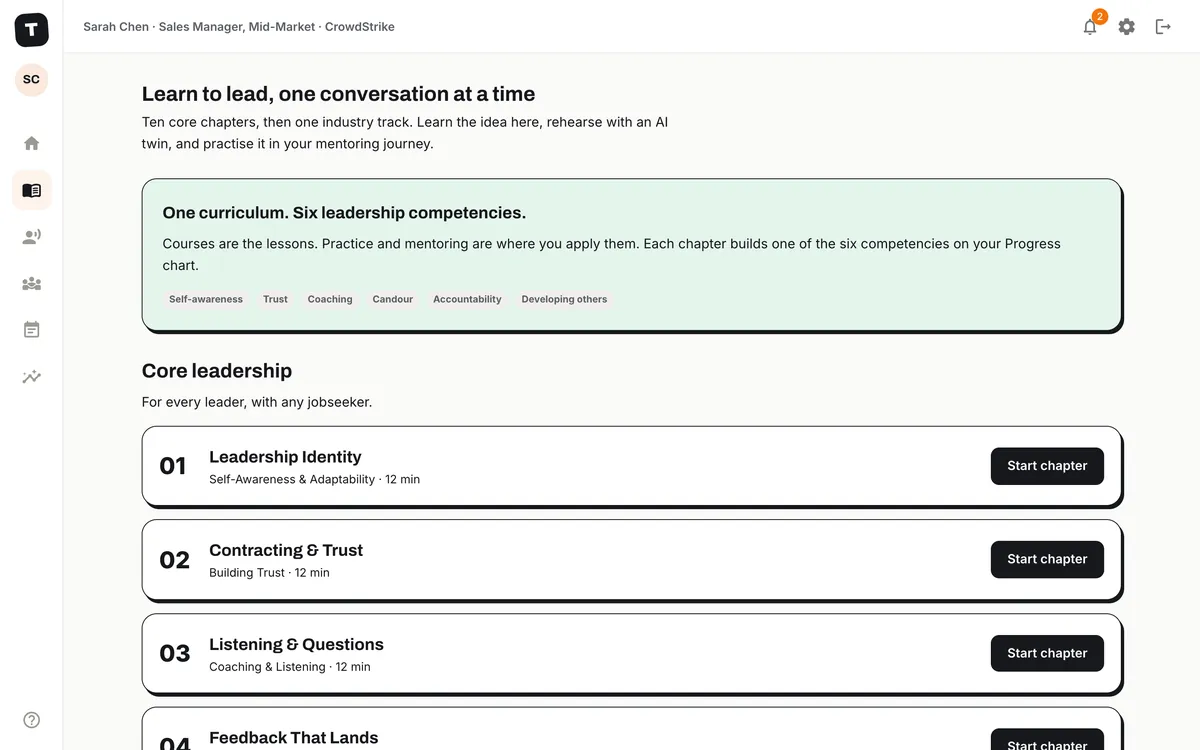
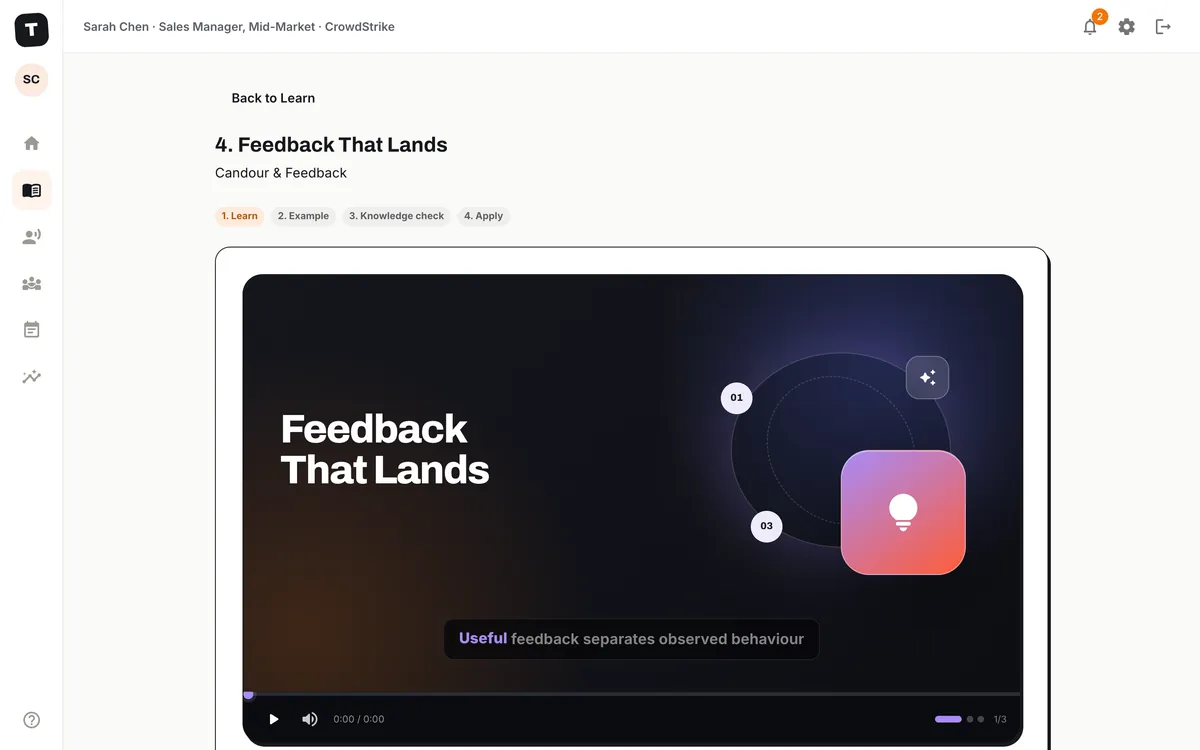
Learn: 18 narrated chapters, each ending in a knowledge check and a rehearsal
Ten core chapters, then a four-chapter track in tech sales or customer success. Each chapter is a slide deck: a cover, a narrated video lesson, the idea, a framework, a worked example and a per-question knowledge check. Narration is generated once per scene with ElevenLabs and cached. If the provider is unavailable the lesson still plays, with browser narration and captions.
Chapters open in any order. An earlier version gated them, and the gates kept drifting out of sync across screens, so the ordering became a suggestion and the product got simpler.
4
Practice: a live voice rehearsal against an AI mentee, scored the moment the call ends
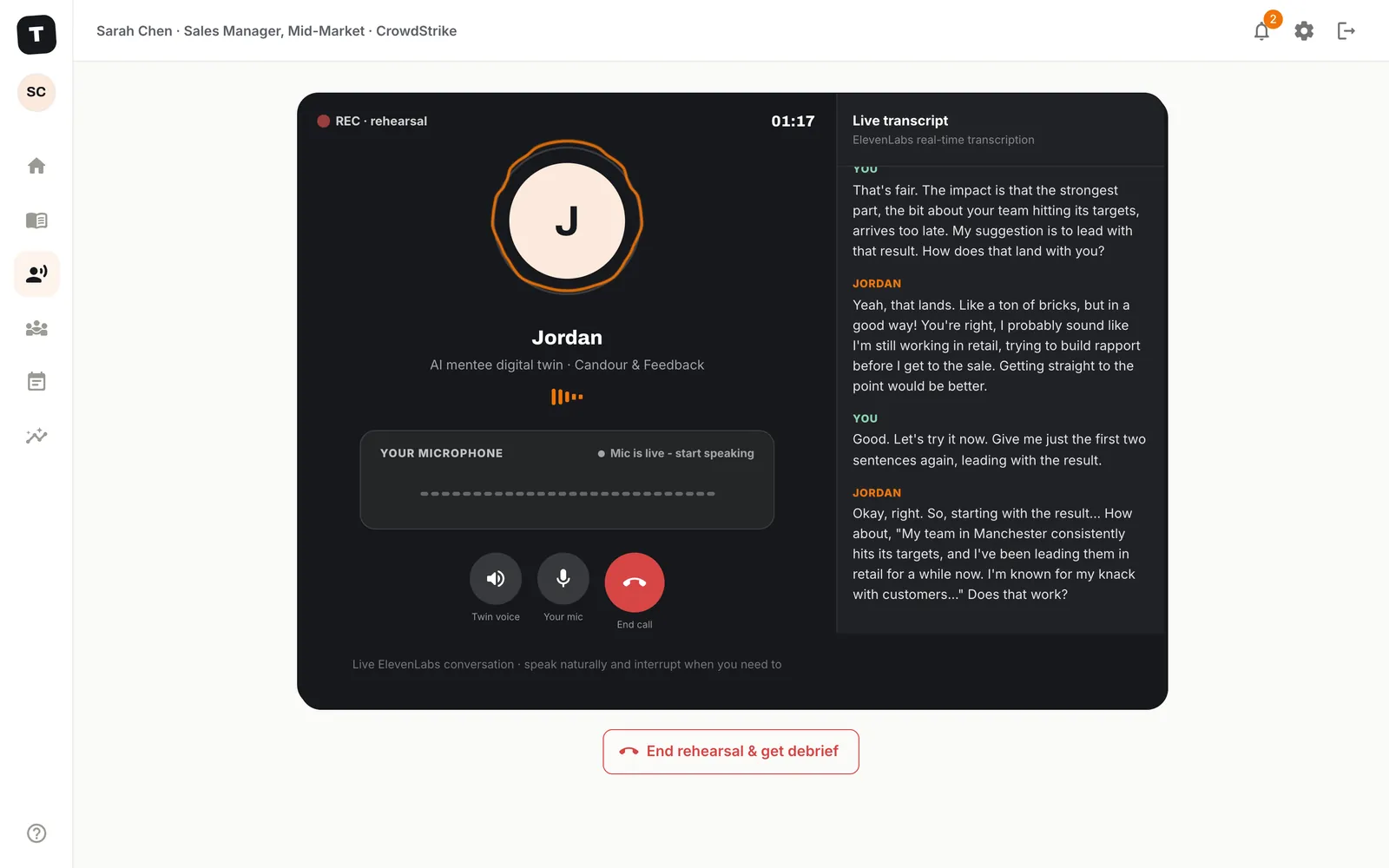
Every chapter has a scenario. The mentor reads a brief about the jobseeker they are about to coach, consents to the recording and holds a real-time voice conversation with an AI mentee who plays that person, in a British voice matched to the character. An audio-reactive aura shows who is speaking, and the transcript builds as they talk.
On hang-up the transcript goes to Gemini with the scenario and the chapter's competency rubric. The result comes back as structured JSON, is checked for shape and range, and is saved as a debrief: what worked, what to sharpen and a score per behaviour.
 Practice
A rehearsal call, step by step
Who does what, from picking the scenario to the scores landing.
The mentor picks a scenario, reads the brief and consents to the recording
The server swaps its ElevenLabs key for a short-lived signed URL. The key never reaches the browser
The AI mentee joins the call with this scenario's persona, situation, objectives and guardrails, in a British voice matched to the character
The mentor coaches, live, over WebRTC. Both sides appear in the transcript as they speak
On hang-up the transcript goes to the server, which attaches the trusted scenario and the competency rubric
Gemini returns strengths, sharpening points and a score per behaviour as JSON, checked for shape and range before anything is saved
The mentor reads the debrief. The behaviour scores land on their progress chart
- the mentor
- the AI
- the server
5
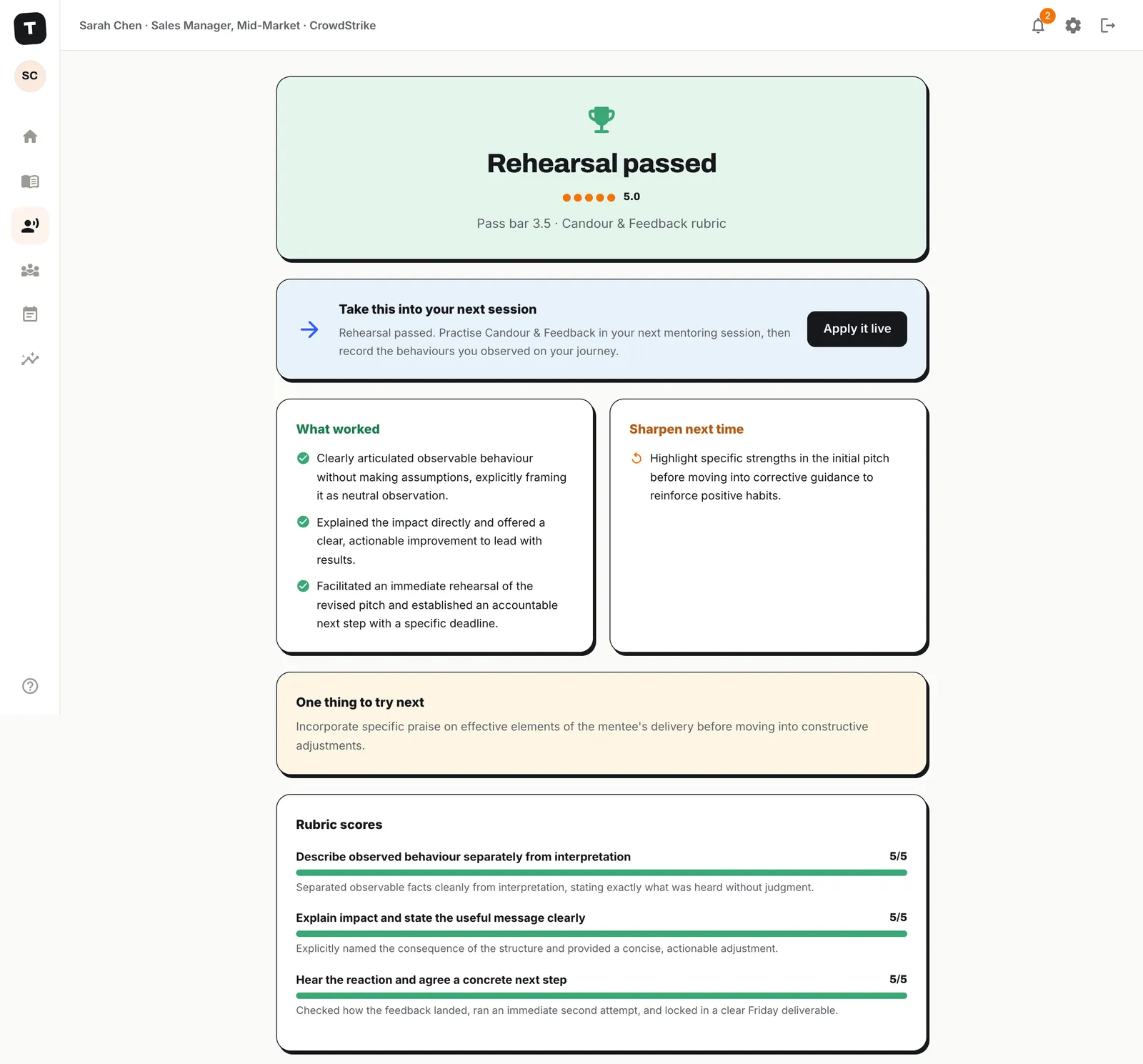
The debrief scores the transcript against the chapter's three behaviours
The debrief is the product's honest moment. It says what worked, what to sharpen next time and one thing to try, then scores each of the chapter's three behaviours out of five with the line from the transcript that earned it. A pass bar of 3.5 decides whether the chapter is done. The rehearsal below was run for this page, with the mentor's side spoken from a script; the transcript and the scores are what came back.
6
Progress: a score moves only when a rehearsal earned it
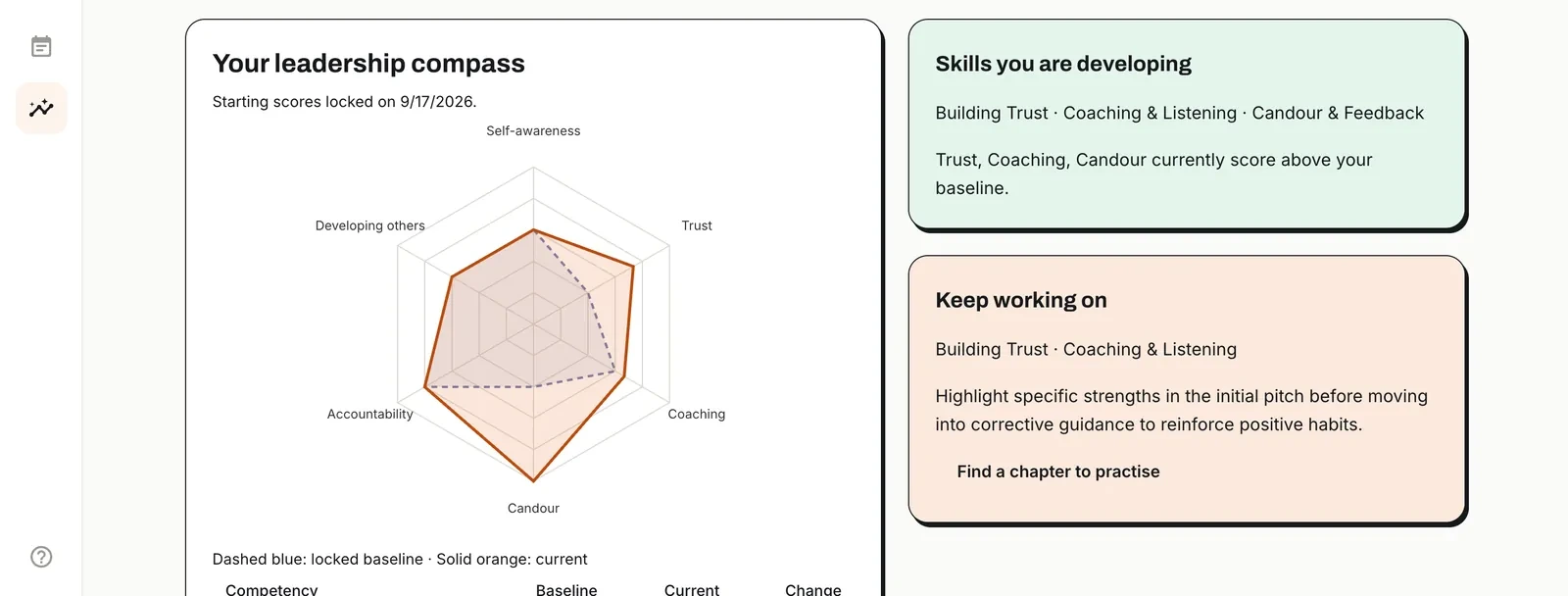
Each competency is the mean of its three behaviours, using the latest assessment of each. A rehearsal moves a score because Gemini scored the transcript against the chapter's rubric. Finishing a chapter or passing a quiz never does. Scores can fall as well as rise, and the progress page keeps the locked baseline beside the current value so the change is visible.
 Progress
Building Trust
The mean of the three behaviours' latest scores: 5, 4 and 3.
Agree scope, frequency and confidentiality explicitly
- 3self-report
- 4AI rehearsal
- 5AI rehearsal
Keep boundaries and follow through on promises
- 3self-report
- 4AI rehearsal
Close with a progress summary and onward plan
- 4self-report
- 3AI rehearsal
Example scores, oldest at the top of each trail. A score can fall as well as rise, and only the latest assessment of each behaviour counts.
7
Reports for L&D leads, and a curriculum studio to change the course without a developer
Sales and L&D leads see sign-ups, training completion, competency coverage across the cohort and example AI feedback, and can download a standalone manager report that prints to PDF.
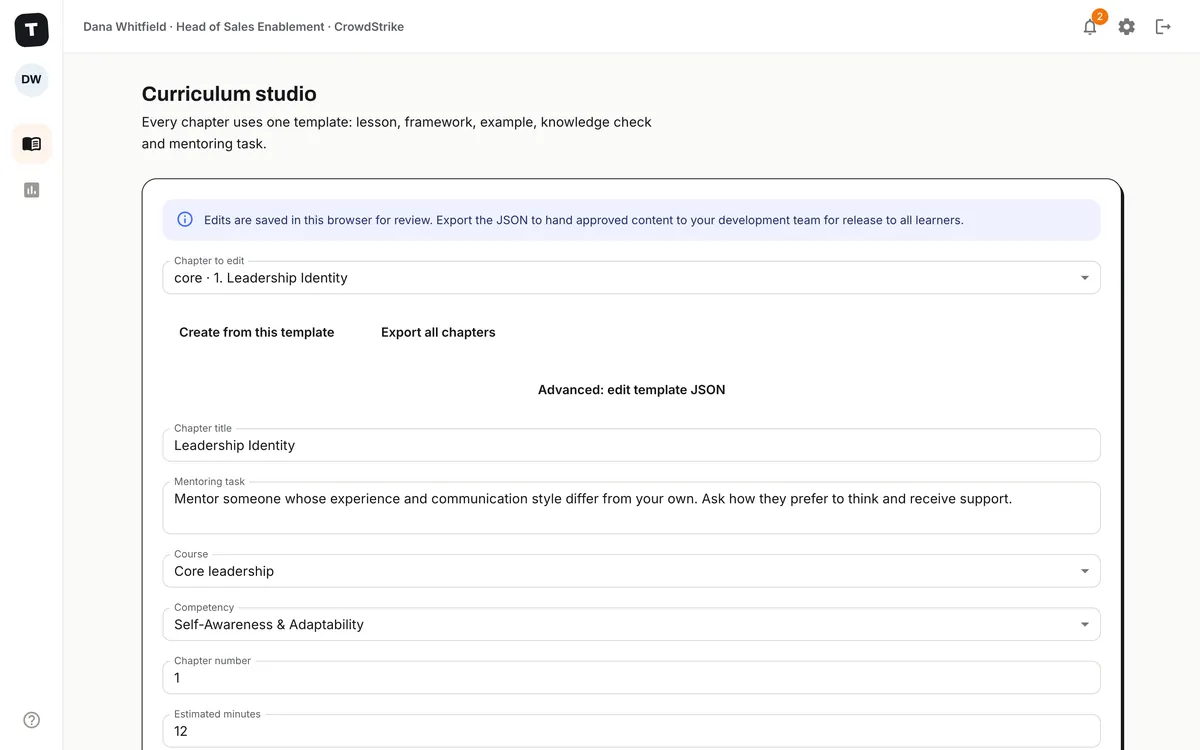
The curriculum studio lets them edit any chapter's title, competency, lesson, worked example and quiz from a shared template, create new chapters, preview them and export the catalogue.
8
Architecture
Three route handlers sit beside the app: one swaps the ElevenLabs key for a short-lived signed URL, one runs the evaluation, one generates narration. The API on Cloud Run in Tangent's Google Cloud project answers only a same-origin proxy that signs each request as the frontend's own service account, with a GET-only allowlist. The app degrades on purpose: no provider audio means browser narration and captions, and no cloud means bundled data and a badge that says so.
For the four-week demo, product state is a reducer persisted in the browser, with every action mapped to a named endpoint on the Cloud Run service, so moving it server-side is one swap point rather than a rewrite. The Postgres schema, seed data, container and build pipeline are in the repository.
HandoverIn the browser
- The app
Next.js and MUI in Tangent's own style guide, with Framer Motion for the small movements
- Product state
A reducer persisted in the browser for the demo. Every action maps to a named production endpoint
- The voice call
WebRTC straight to the AI mentee, on a signed URL that expires
On the server, beside the app
- voice-session
Swaps the ElevenLabs key for a short-lived signed URL
- evaluate
Transcript plus the trusted rubric to Gemini, validated JSON back
- narration
Lesson audio generated once per scene and cached
- gcp proxy
GET-only allowlist, signed as the frontend's own service account
Providers and Tangent's Google Cloud
- ElevenLabs
A conversational agent for the mentee, text to speech for the lessons
- Gemini
Structured evaluation of every rehearsal transcript
- Cloud Run API
Fastify, never public. Reads from Postgres on Cloud SQL, 19 tables
- Cloud Storage
Reserved for recordings, transcripts and lesson assets
Provider keys stay on the server. The API on Cloud Run answers only the proxy. Dashed: provisioned and empty at handover.
9
Four weeks, tested, and handed over with a transfer checklist
Every week ended with a production preview. By handover the product had seven unit tests over the journey rules and an end-to-end suite that walks first login, the manager report, the mobile layout, chapter completion and authoring.
- Week 1
- The whole front end on test data in Tangent's visual language, the Google Cloud project wired up, and the API locked behind a service-account proxy.
- Week 2
- The production voice rehearsal and Gemini evaluation, narrated lessons, a British voice for every mentee persona and the audio-reactive aura.
- Weeks 3 and 4
- Tangent's leadership framework encoded: six competencies, 18 chapters, behaviour-based progress, the manager report and the curriculum studio. Then the first-login tour, the pill-scale baseline and chapters that open in any order.
- Handover
- A pack that transfers every account, credential and repository to Tangent, documents the architecture, and recommends the order to build next, starting with authentication and server-side persistence.
10
What we can do for you
If you need a product designed and built quickly and handed over properly, including where AI belongs in it and where a person should stay in the loop, contact us.